Tuesday, April 12, 2011
Oui, oui! Rabbit. NOT!
Sunday, January 2, 2011
Squeamish Ominvore

Once, long ago, I was a vegetarian. Now I define myself simply as a ‘squeamish omnivore’.
To explain – I have never seen the Sardinian cheese meant to be consumed maggots and all, and I don’t know how I would fare with that. But washed rind cheese is fine with me, and while we are onto smelly food, so is durian that love-it hate-it fruit of south east Asia, every bit as ugly to look at as some people say it tastes.
There are some things, though, that I’ll be happy if I don’t ever eat again. Witchetty grub comes right up there at the top of the list. Vic Cherikoff is an Australian bush food expert and he was at a food event many years ago, which I also attended. He was determined I should try witchetty grub. These are fat white grubs a few centimetres long, which live underground and are actually moth larvae. I grew up in Western Australia knowing them as bardi grubs. Either way I had no desire to eat one, even though indigenous people regard them as a delicacy.
Vic was adamant I should taste a grilled grub and I gave in when my generally honest husband, assured me he had already downed one. I have to say the taste was not so bad – buttery (some say they are like peanut butter) and not unpleasant – but it was the texture that got to me. Because it had been grilled, the skin was tough and rubbery and I could not chew it and had no option but to swallow it down pretty well whole. It was only after we left the event that my partner admitted he had disposed of his witchetty grub in a convenient nearby potted palm!
Chicken’s feet in China, or in any dim sum restaurant for that matter, need never be on my plate again either. Nor sea cucumber which I once ate (no, I didn’t – it was like chewing an eraser so I spat it out) at a Vietnamese wedding, and water rat (in France – that story coming up soon) or raw crab in Seoul. Even my Korean guide shuddered at the idea of eating that.

In China I have been served pigeon (or some entire small bird, with its head hanging over the edge of the bowl) and camel, alligator, caribou, snails and frog’s legs in other countries.

Then there is what I call shudder-territory. I hope I am never in the position of being expected to eat any of these creatures – or parts of them: crickets, bugs, snakes, centipedes, dog, cockscombs, bull’s ‘bits’, lark’s tongues, silk worms, duck webs, white veal (aka the unborn foetus), partially developed chickens still in the shell, puff balls, eyeballs, snake blood or fallopian tubes!
There’s a lot to make you think twice in this omnivorous world. So, how about a nice drink to calm our nerves?
But not tequila, please. I hear there are worms in that!

Friday, November 19, 2010
Hamming it Up

When most of us think about ham we immediately know where it comes from. Right?
Wrong!
‘Ham is a process,’ I am told by Glenn Martin at the recent Restaurant 10 Exhibition at Moore Park, Sydney. ‘Almost any meat can become “ham”.’
Martin works with Seven Hills Tallarook, a Victorian breeder of Australian Boer goats and a purveyor of goat meat, and he should know.
I tasted the Seven Hills chorizo sausage, one of the range of smallgoods supplied by this firm and it was really good. Not too spicy, with a beautiful rich flavour. It cut well and the pack I bought did us very nicely in a paella later that week.
Goat meat may be referred to as cabrito when it is from kids, and chevon from older goats. The meat from these fine-looking Boer goats, which originated in Africa, is also used to make ham which is sold whole or sliced in packs. There is also a variety of meat cuts available online. Seven Hills also have Arabian goat sausages and Mediterranean goat sausages.
So what does goat ham taste like?
It has a slightly more meaty flavour, but the texture is so much like ham you would not really pick it as from another animal. And of course it can stand in for regular ham in any way you would normally serve it. It’s also a useful alternative for those who cannot or will not eat pork products.
Goats are raised and their meat is eaten in many countries worldwide. It is lower in total fat, saturated fat, calories and cholesterol than traditional meats, higher values in iron, potassium, and thiamine together with less sodium. Chevon is usually around five percent fat, 50 percent less fat than beef, 45 percent less fat than lamb. By comparison, kangaroo has about two percent fat.
More details www.sevenhillstallarook.com.au
Wednesday, November 10, 2010
Stone Pancakes
There’s a joke in Australia that if you want to make a soup from a cockatoo, or any member of the parrot family, you need to add a stone to the pot. Cook the soup until the stone is tender, old-timers will tell you, and then maybe the parrot meat will be edible!
These days it’s illegal to eat these native birds, and anyway I wouldn’t want to. But it sounds as implausible as ‘stone pancakes’.
We were at the restored village of Pinyao in Shanxi province, northern China, where the 14th-century Ming dynasty buildings have been painstakingly restored.

The nearby Qiao Family Compound was the set of Raising the Red Lantern filmed in 1991. A few years ago a popular TV series was also shot there, so we found endless groups of people posing for photographs in front of the stars’ posters on the walls.

But the thing that got my attention was just outside the compound gates where dozens of vendors had set up their stands and charcoal braziers. The cooks were using a short rolling pin to roll out small pieces of dough into thin circles the size of a dinner plate. These were then draped over smoking hot stones in pans and then covered with more round hot black stones.


These wafer thin pancakes – breads? – cooked in just seconds and kept the shape of the stones. Their dimpled surface was intriguing, almost waffle-like, and of course I had to sample them – as did every passing tourist, because the scent was irresistible. They were meltingly delicious with just a hint of the black sesame seeds or finely sliced green onion with which they had been sprinkled. We discovered later they were unimaginatively called shi tou bing (stone pancakes).

It was impossible for me to get the recipe, but my guess is it was simply a dough of wheat flour and water, the sort of basic bread people have always baked. They were cooked in the simplest way, using a pan that possibly did double duty for other cooking, the stones adding weight to prevent the pancake curling up, as well as an even heat to cook them quickly and keep them crisp.
When I think about it, I’ve got something similar in my own kitchen. Except it has two flat metal plates and I call it a sandwich press!
Monday, November 1, 2010
MANY HAPPY RETURNS
English writer, Evelyn Waugh, once famously accused the whole country of Norway as ‘smelling of kippers’.
I reckon I’m smelling of kippers as I stand surrounded by thousands of herrings, gutted, salted, split open and tanning slowly in the smoke of perhaps Britain’s most prestigious kippery.
Craster Kippers has been catching, smoking and distributing this breakfast-time delicacy for over 150 years in the small Northumbrian coastal village of Craster, near the picturesquely-named Seahouses. Until now, I have only encountered them on the occasional British breakfast menu. Now I am in danger of becoming smoked too.
Experimenting with local flavours, I once ordered one in England, then my companion warned me “you’ll enjoy that for the rest of the day”.
Well, “enjoy” may not have been the correct term, but I certainly remembered my morning kipper for several hours as its fumes indigestibly returned to me.
So what is a kipper? Kipper-meister, Neil Robson, who guides us around the smokehouse, explains that the fish used today are mainly Norwegian herring, available year-round, although when the North Sea was fished out and there was a ban for seven years, they bought their herring from Western Scotland.
‘Once nearly every village had a smoker,’ he tells us. Only one was left in 1856, so for four generations since then his family, the Robsons, have been keeping the fires alive. Literally.
Only the plumpest fish are used, he assures us, and today they are split by machine, before being washed, brined and hung on hooks) before their time in the smokehouse.
‘They go in as herrings,’ says Neil, ‘and come out as kippers!’
It’s actually the smoke that gives each kipper a distinctive flavour. At Crasters they use oak shavings and the fish stay in those scented fumes for 14-16 hours.
Seems no one is too sure where the name came from (maybe Old English, maybe German, maybe Icelandic) but “kipper” has entered our language. Originally salmon were used, but herring became the fish of choice for kippering after the 19th century. Now other meats may be “kippered” which means they have been salted and smoked.
Kipper season comes at a time when salmon are off-limits for fishing, and it makes good sense that throughout the world’s colder countries fish is salted, smoked, cured or processed to keep it available for winter.
With facts and figures swirling like smoke in my head, there was just one more thing to ask Neil Robson: How do you actually cook a kipper?
‘Easy,’ says Neil. ‘This is my way. Take a jug of boiling water. Stand your kippers in the jug for two minutes with their tails sticking out of the top.’ Now that’s a technique from an expert I shall use – if I ever need it.
So far I have tried Arbroath smokies (smoked haddock) in Scotland on the famous train, the Royal Scotsman – at breakfast of course! And I’ve sampled bacalau, Portugal’s iconic salted cod, used in a multitude of dishes. But I’ve yet to have Finnan Haddie, Scottish smoked haddock.
As you’d expect it’s possible to order kippers online http://www.kipper.co.uk/ but don’t be surprised if you get a funny look from the postman.
Just tell him you’re expecting him to wish you Many Happy Returns!
Thursday, September 30, 2010
AS BLACK AS SALT

How would you reply if you were asked “now, would you like white pepper and black salt with that?”.

But I had never seen jet black salt before.
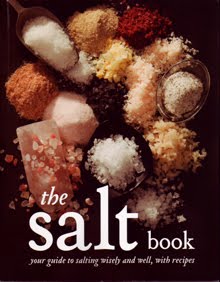

Who knows!
First-century AD Roman author and naturalist, Pliny the elder, not always the most reliable scientific guru, refers to Cyprian salt as a “precious stone”. In its white state it was also mentioned by Hippocrates, the father of medicine. It is usually collected from coastal rocks as well as from the island’s salt lakes.
No wonder these scholars mentioned it. The Romans valued salt enormously and even paid their workers in it, which is where we get our word sal-ary from. The ancient Roman road, the Via Salaria, is still a major road leading to Rome.
And finally, just a bit of trivia: A couple of years ago I visited the Ile de Ré, just off the Atlantic coast of France. Esprit du Sel salt is still harvested from the marshes at the far end of the island and the local donkeys were once used to transport it. Unfortunately the mosquitoes and the corrosive salt irritated the legs of the poor beasts and so the farmers clad them in checked trousers for protection. The donkeys in their unusual garb became a sort of unofficial emblem of Ile de Ré.

Thursday, September 16, 2010
A PASSIONATE TALE

I’ve been passionate about passionfruit all my life.
As a kid, growing up in a small country town in Western Australia, everyone I knew grew passionfruit – especially the long yellow ‘banana’ passionfruit. These hung off creepers that many people trailed up over the walls of the outside toilet to discreetly camouflage it – yes, it was that long ago!
I must have eaten hundreds of those. For a kid, the soft velvety skin made it so much easier to break into the fruit. Those hard purple passionfruits – much more common – required a knife and possibly adult help to open. And that was a problem, too, as they could then keep tabs on how many you were consuming.
The banana passionfruit (tacsonia) was fun to eat. Peel the skin and you then had a long ‘banana’ of closely packed, sweet, orange-fleshed seeds that broke away from each other cleanly with no juice. You could legitimately spend half an hour savouring one fruit, picking off each individual globule.
Often I didn’t, though, simply eating it monkey-fashion, the peel laid back, gobbling the sensuous sweet flesh.
Years later I found myself in Bali and met the fruit to rival my previous passion.
Like many a romance, it began fairly slowly and inauspiciously. A yellow egg-shaped fruit appeared in the breakfast buffet fruit bowl. Hmmm! A bit spotty, not much to recommend it. Unlike a ripe purple passionfruit, the skin was hard and smooth, not invitingly wrinkled.
It wasn’t much better when I cut it open. Silver grey gooey flesh around black seeds – almost like fish roe.

A cautious sniff. And a taste. This was certainly better!
I put a spoon into the half-shell and the entire glob of flesh came out obediently. No scraping as I was used to with the golden flesh of the purple passions.
And then the taste – fragrant, floral, sweet, tropical. Lychee-sweet, but the texture of passionfruit.
Of course for the rest of my time in Bali, I could not get enough of them. Everywhere, from the hotel breakfast buffet to roadside stalls where they sold for a pittance, I would fill my pockets with them, to savour them in my room as long as they lasted.
Originally I thought the name was Marquesa. It took me months to learn the Balinese name was makisa, pronounced, mah- KEE-za. I now know that the makisa has a more proper Latin name - passiflora ligularis – and that it is said to be native to the Andes. How it became so entrenched in Bali (and only few other places) is a mystery to me.

Sadly this passionfruit is rare in my corner of the world. In Bali, I am told it ripens year round, but even in Jakarta earlier this year, it took a patient hotel employee some time to track some down for me when he heard of my addiction. Thank you, Adeza, at Hotel Mulia Senayan!
Is it just me, or are there other people who plan their trip around which rare or much-covered foods are in season?
My mouth is watering, just mentioning makisas, so I’m scanning the deals on flights to Bali, right now!


