Tuesday, September 7, 2010

COFFEE ANYONE?


The first time I heard about kopi luwak I checked the date. Was it April Fool’s Day, perhaps?

After all, who, seriously would consider drinking coffee that has passed through an animal’s digestive tract? And why would you anyway?

I must admit I find it difficult to refuse a nice cup of coffee, but in this case my imagination was getting the better of me. Sure, it had made it onto Jack Nicholson’s ‘bucket list’, but did I want it on mine?

In case you haven’t heard, kopi luwak is made from ripe Arabica coffee beans that have been ingested by a sort of wild cat – the Asian palm civet (Paradoxurus hermaphroditus), found in Indonesian forests to be exact – which then defecates them onto the forest floor. Enzymes act on the berries in its gut and this is widely believed to be the key to the enhanced flavour.

Ok-a-a-y!

Stop right now and just think about this for a moment. You’re strolling through a tropical forest and come across some rather lumpy animal poo on the ground. What would be your first reaction? Would a steaming cup of coffee spring to mind?

Who would have been the first to think to collect the faeces, wash out the coffee beans, dry them, roast them, grind them – and then (ahem!) drink the brew? It is quite frankly well outside of my own realm of usual Health and Safety considerations.

And yet it has been done for quite a while and sold at exorbitant prices, up to $50 a cup (goes to show, doesn’t it?) at good addresses.

Earlier this year I came across it a little closer to the source. I spotted a kopi luwak sign in a shopping centre in Jakarta, and then later at the opulent Hotel Mulia Senayan, perhaps Jakarta’s most upmarket hotel, where the sparkling coffee shop sells it. I knew then I had to taste a cup. Squeamishly.

Now, my head told me that there should be no problem, healthwise. All the literature explains patiently that the washing, drying and roasting of the beans at high temperatures kills whatever ‘baddies’ might have been lurking in the civet’s gut, but……. Hmmmm!

Aficionados of this unique and expensive cup of caffeine have waxed lyrical about the ‘earthy aromas’ (well, you’d expect that wouldn’t you?) and full bodied flavour (ditto). Milkier. Smoother. A pleasant touch of sweetness. Some call it one of the world’s greatest gourmet experiences.


As it happened, my cup of kopi luwak looked like any other coffee. It came in a regular cup, on a saucer, and tasted fine – but not sensational. What did I expect?

Now back in Australia, I am off to another place I have heard of in Sydney that does a good brew of it, for $9 a cup, to try to see what all the fuss is about.

Has anyone else tried kopi luwak? What did you think of it? Or have you drunk something else that was a little off the radar?

+++

Hotel Mulia Senayan, Jl Asia Afrika Senayan, Jakarta, Indonesia, www.hotelmulia.com

Olio Mediterranean Brasserie, Shop 1P1, 201-205 Pacific Highway, St Leonards, 02 9439 8988, info@olio.com.au, www.olio.com.au B, L, D, Bar and catering.

Saturday, August 14, 2010

TRUFFLE TRIVIA

“Will you be able to keep what you find?”

That’s the question everyone asks when I tell them we are going on a truffle hunt.

Of course it’s not that sort of a ‘hunt’, I explain. Ex-Customs sniffer dogs do the actual searching, and anyway at around $2000 or so a kilogram, truffles are far too valuable for tourists like us to simply scavenge.

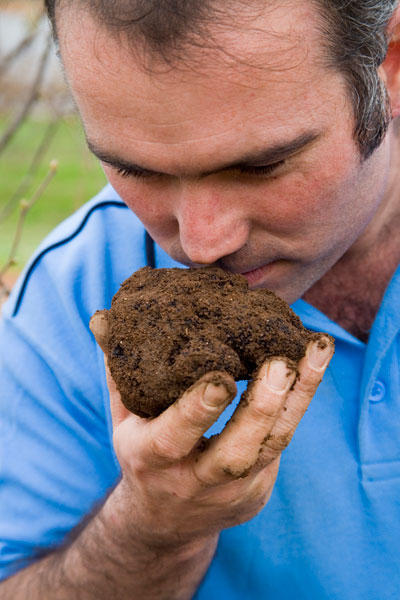
Besides, I’m not sure I’d know what to do with one – a whole one – if I ever found myself in possession of it. While I’d never say no to a truffle of the chocolate persuasion, these fellows are the real deal: roundish, knobbly, pockmarked and liberally covered in soil, not with a genteel dusting of sifted cocoa ready for afternoon tea.

No beauties these, to be sure, yet their flavour and scent have evoked crimes of passion and intrigue, and at the very least, seduction. “Mud cooked by lightning”, Plutarch called them.

Right now it’s truffle harvesting time in Australia, and they’re popping up all over the country. Tasmania was the first state to plant and harvest them, but now good finds are being made at groves in NSW, Victoria and WA.

Black beauties from Truffles Australis

These are the winter black truffles (Tuber melanosporum) beloved by the French, and found most notably in the Perigord region. Word is that some places in Australia are also currently trying to raise the rarer white truffle most commonly unearthed around Alba in northern Italy.

But something you may not know is that Australia has its very own truffles. You won’t find theses indigenous, native truffles on anyone’s menus, though. Not unless you’re a potoroo, bandicoot or native mouse. These animals must be natural gourmets because they love them, digging them up from the base of paper bark trees, eucalypts, casuarinas, and many other native shrubs.

I’ve never seen these wild truffles, but I’m told they may smell faintly of peanut butter or bubble gum. Or several far worse smells – just use your imagination for those!

What’s more, although about 250 species have so far been indentified in this country, it’s possible there could be as many as another thousand or more varieties lurking out there in every sort of environment from lush rainforests to the arid inland mallee areas.

So, although it seems Australia has an inexhaustible range of truffles, in all shapes and sizes (and odours) they’re not about to catch on too soon. I reckon I’ll stick to the good old black ones.

That’s if I can afford them!


Wednesday, August 4, 2010

FAUX FOIE GRAS


It’s hot. It’s steamy. It’s Tahiti. Well, Moorea anyway – one of French Polynesia’s many, many breathtakingly beautiful islands.

OK, we’re not even there. We’re actually on a motu (a coral island) off Moorea.

Our pareo-clad hostess has seated us at a rustic table on the sand, just a couple of metres from the water’s edge. And we’re about to deal with a huge platter of speckled ruby red coconut crab.

But before we start to hammer open the claws (forget regular crab tools, these fellows are whoppers: we have each been equipped with a small mallet and a block of wood to get at the sweet flesh) our Polynesian hostess, Maire, wife of French-born chef, JP, shows us an even greater delicacy.

“Before we prepare the crab we feed it on coconut for days,” she says, cracking opening a section as big as the body of a normal crab. “When we cook it, this – the crab’s liver – becomes our foie gras!”

Crab liver? Not force-fed goose liver? Could this be the South Pacific’s answer to an ethical dilemma?

At Maire’s urging we dip our knives into the creamy mass and spread it on crusty French bread. It turns out to be just like the real thing, too, but with the faintest hint of coconut, as you’d hope. Who cares that we never knew crabs had livers until this moment?

Coconut crabs are the world’s largest arthropod. That’s any beastie with a shell, not a spine. Technically they are in the same classification as spiders and scorpions and a whole host of other things I don’t want to eat and which probably don’t have livers anyway.

As you’d expect from its name, the coconut crab is happiest hanging around coconut palms, of which its habitat – the Indian and Pacific Oceans – has many. While they can climb trees, they wait until the coconuts fall to the ground before relishing them.

Just imagine how a quiet beach walk would turn scary if you encountered one of these individuals as they often measure a metre across and are said to weigh as much as 16 kilograms.

Predictably, coconut crabs eat coconut, which would be a problem for them if they were not strategically equipped with pincers strong enough to crack the shells and allow them access to the sweet milky flesh. Comparing my fingers, arms, legs to the toughness of a coconut, suddenly I’m glad the one I have encountered on this beach is safely cooked and glowing temptingly on my table!

As we get our mallets and stones to work on the flesh of the crab, it turns out to be tender, delicious and of course plentiful. Some say it’s an aphrodisiac.


I know I have certainly been smitten by its foie gras. Just my luck to fall for something so rare, so distant, I may never come across it again, I think.

Oh, well, that’s love for you, I guess!

Wednesday, July 28, 2010

ANYONE FOR A BIRD’S NEST?


Our Malaysian guide Ping Ping loves her food. We know this because she talks about it – a lot. When we walk on along the riverside in Melaka for a few minutes, she stays behind, and admits to us when we return that she has used her time well.

Call it reconnaissance if you like. Maybe research, but she’s been snacking on a special – ‘very special,’ she says – delicacy.

She quickly hustles us into the air-conditioned and spotless Yong Ann Birds Nest restaurant (www.yongann.com) where we are seated on wooden chairs. She urges us to taste the café’s specialty which, she underlines, has been harvested at great risk. We give in to please her, and Ping Ping orders a second helping of bird’s nest tart for herself.

The menu in this small unprepossessing café offers a range of dishes, all featuring this rare ingredient. Under Ping Ping’s close scrutiny we order some desserts and a ginseng birds’ nest drink. She has already half-consumed the last tart in the shop.

I feel she really doesn’t mind at all if we don’t like our choices as she will happily clean up the leftovers. Did I mention she quite visibly loves her food?

It’s only when, as the sweetly gelatinous substance slips between our teeth, that we are told what it really is, and realise queasily what we are eating. This bird’s nest is not exactly the bird’s nests, the bedroom and nursery built by tiny cave swifts. That had seemed bad enough. But it’s worse. It’s the bird’s own dribble!

Melaka is one of Malaysia’s oldest cities and perhaps the second most important tourist destination in the country after KL. The food here showcases Malaysia’s wonderful mix of Indian, Malay and Chinese, with a touch of Dutch and Portuguese and the magic fusion of Malay and Chinese in its Nyonya cuisine

But Ping Ping wants us to experience a Chinese delicacy- and we’re not sure we want to.

First some history. The shallow cup-shaped nests are built by tiny male swiftlets, and are usually stuck on to the walls of coastal caves in Indonesia. Harvesting these is perilous and, you could argue, ecologically wilful. They are said to be one of the most expensive animal products in the world. Regardless of this, the Chinese have been savouring this delicacy for at least four centuries.

Because these nests are not made from straw and hair and the usual bird’s nest building materials, the ‘interwoven strands of salivary laminae cement’ are able to be dissolved in water to give a silky texture to soups and desserts and to impart a certain flavour to ice creams.

Typically, the health-conscious Chinese believe that eating these nests (which are high in calcium, iron, potassium, and magnesium) provide health benefits. It seems that after this our digestion, concentration, immune system, and, yes, of course – the old standby­ ­– libidos, will improve.

There are both red and white nests, and a red sells for about five times the price of a white one. To one side of the café there are shelves holding packages of bird’s nests products and they are certainly not cheap. However, even if the flavour or cost or ethics don’t stop me buying one as a souvenir (and they do), I am pretty sure my own country’s quarantine restrictions would.

So what does it actually taste like? I nibble some mango bird’s nest ice cream before pushing it across the table to the helpfully available Ping Ping.

Hmmm, unremarkable, I decide. Sweetish. Nice texture. Certainly not worth the danger for the harvester or the loss of a home for the swiftlet family. And, although it’s a possibility that perhaps I need to have consumed more, I just don’t feel markedly healthier afterwards.

Perhaps Ping Ping does. She’s smiling and looking very content. But then she’s possibly put away three or four good helpings today!

Wednesday, July 21, 2010

NATIONAL LAMINGTON DAY


Like most Australians, I probably met my first lamington before I can remember it. Kids love them.

And let’s face it, there has to be something about a country that has such a thing for stale sponge cake covered in chocolate icing and furry with desiccated coconut! There’s even a National Lamington Day – and today is it!

Over a hundred years ago, a French chef in Brisbane – now there’s a cultural divide to begin with – first knocked up an impromptu batch for some guests having afternoon tea with Lord Lamington, the second Baron of Lamington and Governor of Queensland from 1896 -1901.

No doubt wanting to keep his job, on the spot the chef obsequiously dubbed them ‘lamingtons’, and undoubtedly the good Lord did nothing to let the guests know that they weren’t biting into the results of an ancient family recipe handed down throughout the centuries along with his title.

The concept of lamingtons is simple: cut stale cake into large cubes, dip these carefully into thinnish chocolate icing, then toss in coconut. Please note: the pertinent word here is ‘simple’.

The one and only time I tried to make this staple of all good CWA cooks, P&C mothers and fundraising organisations (think, lamington drives) the word ‘simple’ was a long way from my vocabulary, which turned shorter and pithier as I became more and more coated with the major components.

Unless you have done this several dozen times, the whole crumbly cake, sticky icing, coconut routine is NOT simple. I had icing on my hands, face (well I had to lick my fingers!), cake rack, floor, clothes, cupboard doors, bench tops – ditto the coconut. Everywhere, it seemed, except on the cubes of cake which stubbornly sprouted bare spots as the icing refused to adhere and began to drip off onto my hands, cake rack, floor, clothes, cupboard doors, and bench tops.

In a clever example of role-reversal, the bowl of icing became crumbier, as an exchange plan between it and the cake cubes came into effect.

Despite my shambles of an effort, lamingtons remain a favourite of mine. A staunchly Aussie food icon they are available in every cake shop and supermarket and sold in dozens for charity. My private guess as to why they sell exceptionally well is that they are so tricky for the not-too-talented-and-coordinated home cook to execute.

Me? I’ll buy any number for a good cause. I am just happy to let the experts make them, rather than go through another ordeal like that.

National Lamington Day today – go buy a few dozen!

More information: http://en.wikipedia.org/wiki/Lamington

Tuesday, June 15, 2010


THE KING AND I

Durian, known as the 'king of fruits' in south-east Asia has, to put it mildly, a distinctive odour. ‘Dis-STINK-tive’ would be more appropriate, many might say.

“How can you put something that smells so bad in your mouth?” a non-durian lover once asked me. “Well, what about washed rind cheese?”, I countered. “Or cooked cauliflower. Or gorgonzola.”

Durian has some pluses though. It makes up for its ugly look – picture a pineapple on a really bad hair day – and whiffy aroma, with a creamy sweet flesh. In fact once people know the taste-sensation in store, many quickly go from 'ugh! what's that dreadful smell?' to 'durian! where is it?'.


On a recent trip to Penang, Malaysia, as we leave Batu Ferringhi on the north of the island we know what we are craving. Durian. But it’s a problem. If we buy one of these huge thorny khaki beauties from a roadside stall the hotel will never let us inside with it. If we eat it in the rental car, the company will possibly add a surcharge.

Around the north-western tip of this lovely island, often called the Pearl of the Orient, the jungle is tangled with creepers, denser than on the eastern hugely-developed side. Here, nets hang hammock-like beneath giant jackfruit and durian trees to catch the heavy fruit, and somewhere in the shadows grow nutmeg and clove trees.

We drive on, past crude wooden roadside stalls sheltering mounds of this thorny football-sized fruit and are finally rewarded with the answer to our craving.

The 10 hectare Tropical Fruit Farm at 250 metres altitude, overlooks deep jungled valleys that disappear kilometres away into a glimpse of water and the haze of Georgetown, the capital, on the east coast. It should be called Eden because almost every known tropical fruit grows here.

In the farm shop we discover dried and fresh fruits, bunches of rambutans and mangosteens, pineapples and tiny bananas in crates and there is a whole stand of local nutmeg oils and balm. In a chilled cabinet, spotted and weirdly coloured Vietnamese dragonfruit and other fresh fruits are laid out ready to combine on fruit platters.

A spiky mound of durian lies on the floor to one side, and instantly we know what we will be ordering. The durian season runs from the end of February to August. It’s April, so we are in luck.

We select a top-grade one for under A$5 and the assistant chops it open to reveal smooth yellow segments buried in cavities inside. The rest they can leave to us. Seated outside at shaded picnic tables overlooking that magnificent view we pick out the creamy flesh slowly, eating with our fingers and dropping the seeds into a basket below the table. Bliss!


The smell? Well, it’s been described as eating first class custard in a sewer, but that’s too extreme, we decide.

“They smell like hell, but taste like heaven,” says someone else. Despite this, durian’s name has nothing to do with either. It just means ‘thorny fruit’.

It’s pungent, it’s exotic. Faintly redolent of rotting onion with a slight tang of sulphur. Not what you normally associate with fine fruit, but this is Malaysia. We’re in the tropics and this is durian.

And – for us – we are indulging in truly the king of fruits!

Thursday, May 6, 2010

RIVER WINE


‘I call this Gordon River chardonnay,’ says my new friend, David Goodfellow, holding up a glass of golden liquid.

I sniff it. Nup! Not like any chardy I’ve ever tried. I taste it. Definitely not a chardonnay.

Bewildered, I ask: What is it?

Well, it turns out I am drinking river water. But not from just any old river. This is the famed and fabulous Gordon River in western Tasmania, passing through a World Heritage region of the highest order.

The air is clearer here than possibly anywhere else in the world. We are in a pristine wilderness rainforest environment. It’s pure. It’s green on green. And constantly dripping with some of the couple of metres of rain that falls each year here.


So what’s with the brown water? You see, now I know it’s not chardonnay, it looks more brown to me, rather than golden.

‘It’s tannin,’ says David, ‘from the buttongrass. It stains it.’

And what does it taste like? Absolutely nothing, I have to admit.

I guess he could call it rainforest ‘tea’, then, if he wanted to, although it is not being marketed as anything yet. No one has caught on to the obvious sales pitch of ‘World Heritage Water’ or some-such, which is a surprise as Tasmanians are an entrepreneurial bunch. After all, someone on King Island in Bass Strait to the north of the island captures rain and markets it as Cloud Juice!

I doubt anyone has analysed this ‘chardonnay’ to get at its properties, but I am guessing antioxidants could be there, which might make it attractive to healthy types.

Right now the only place you’ll ever be able to taste this is on a cruise along the river from Strahan, a delightful picture book village about halfway down the west coast of Tasmania tucked up on the inner edge of the vast Macquarie Harbour which – get this – is over SIX TIMES the size of Sydney Harbour.

David Goodfellow is the manager of Gordon River Cruises, a company which offers passengers an unforgettable escape along one of the world’s quietest, most breathtaking and serenely beautiful waterways.


Funny thing, the water we are travelling on looks dark blue in the sunlight, but in my glass it is undeniably brown.

Oh, OK David – maybe it’s a bit golden. Perhaps it is a little like chardonnay!