Monday, June 11, 2012

Kimchi and more

A few years ago, I travelled to Korea for a very unusual festival.

Well, it was unusual to me, but for millions of Koreans in their own country and overseas, it  was celebrating perhaps the most important part of their menu. Kimchi.
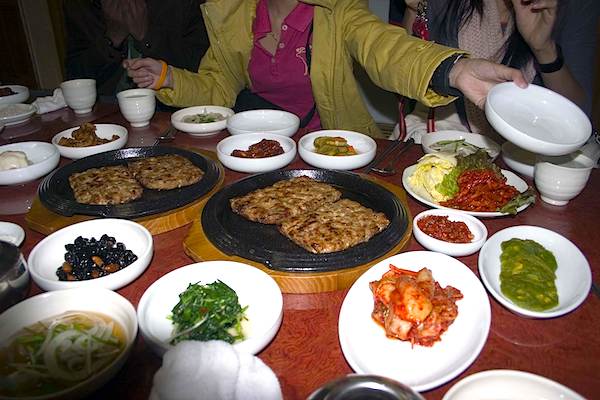

If they know nothing else about Korean cuisine, most people will have heard of kimchi, that fiery, cabbage-y condiment which appears at every meal. And I mean EVERY - breakfast included.

In case this has not entered your shopping list yet, you need to know a few things.

Kimchi is an authentic Korean side dish of pickled vegetables, often (and perhaps mainly) made with Chinese cabbage. However, almost any food can be kimchi-ed, and there are over 170 varieties!

References to kimchi have been found up to 3000 years ago in Korea. Like many countries with cold winters, a way was needed to safely preserve food for use when it was no longer available fresh. Fermentation (think, sauerkraut and pickles in Europe) was the ideal solution.


Although the version most people know involves rubbing a crimson spice mixture between the leaves of brine-soaked Chinese cabbage which is then put to ferment, often for months, in an earthenware pot, there are at least a hundred other types. Even water kimchi, a sort of spicy turnip broth, appears often as one of the multitude of side dishes which are essential at each Korean meal.

Focused as they are on health, the country's 48 million inhabitants believe kimchi is what keeps them well, and some even credit it with protecting them during the SARS epidemic.

There is an annual Kimchi Festival in the southern city of Gwangju and a Kimchi museum in Seoul.

However this is not the only unusual food on tables in Korea. Acorn jelly a wobbly unappetisingly-coloured dish served cold is an acquired taste, as is raw crab which even my guide refused!


In this picture, the roasted chestnuts look delicious, as do the wafer-crisp breads. But look carefully at the simmering pot in the background. Yes, you’re right. Those are silkworm larvae. Having done their work of spinning silk, once it is unwound, they are tossed into a basket ready for their next use – boiled as a protein-rich addition to someone’s lunch. 

Wednesday, February 8, 2012

Beware Indian Figs


One of the most painful foods to eat (painful, that is if you try to handle them with your fingers) are fichi d’India, literally ‘figs of India’ or, as I grew up knowing them, prickly pear.

Anyone who has travelled through Sicily and southern Italy as we did a few years ago (see my book Just a Little Italian) will remember the huge cactus plants growing on roadsides and dotted incongruously in fields.

Those pale-green pads the size of tennis racquets are spiked with vicious thorns, and the plump red or yellow egg-shaped fruit that grow from them are just as dangerous. Their skin is a booby trap full of the finest, almost invisible hairlike spines which attach themselves to clothes and skin without invitation.


So why trouble with such a fruit­ – one that is intent on becoming your enemy, it seems?

Southern Italians have long prized this fruit for a number of reasons. It grows readily in hot arid soil, and it is generous with the fruit it provides. It is free food for foragers, a plus in the past when these regions were sorely poverty-stricken.

After getting our fingers well and truly prickled by the spines in Sicily, we were later told that we should have held them in newspaper while we scooped out the flesh. Some people rub the fruit in sand or swiftly pass them over a flame to remove the spines.

Elsewhere in Sicily, at Modica on the southern coast, in one amazing shop we discovered chilli chocolate and  a liqueur made from fico d’India. The owner warned us that if we ate the chocolate and then drank the  liqueur, ‘then you need someone standing by!’ because of its aphrodisiac results. I didn’t test that tale.


This cactus is only native in the western hemisphere, not on the Indian subcontinent. So why the name ‘figs of India’?

Prickly pear cacti are indigenous to North America, occurring from the arid north-west, through the Rockies, and down to Mexico where they are abundant. They were named for the Native American ‘indians’ and when the fruit was introduced into Europe, the name went with it, at least to Italy. I didn't know that.

Fans of fichi d’India say the flavour is like a cross between strawberry and watermelon, but personally, I would rather eat either of those fruits individually for the rest of my life, (and especially real figs) rather than risk another cactus attack simply to enjoy the flavours in unison!


Do you like this fruit? What is your tip for eating it comfortably? Do you use it in cookery – and if so, how?

Friday, November 25, 2011

Another thyme, please!


My friend Bechora is one chef I absolutely trust my palate and my plate to, so when he brought me a herb from his garden, I was interested.

“Do you know this one?” he asked. Well, it looked a little like rosemary, but the leaves were too soft. It smelled faintly of ….. of what? I hesitated and he helped me out.

“It is thyme. Lebanese thyme.”


Bechora should know. He grew up near Tripoli in Lebanon and he would have often walked through the mountains as a child, crushing this wild herb underfoot. Here, in Australia, he has it in his garden and it grows luxuriantly in the Mediterranean climate of Mudgee in the central west of NSW.

Next morning he surprised us with this herb made his own special way, in oil and lemon juice, and topping slices of toast. Could there be a simpler and healthier way to start the day?


Lebanese people are noted for their generosity and so it was no real surprise (but a welcome and delicious treat) that he packed us a hamper to bring home: pickled pink turnips, glace lemon, a huge bunch of the wild thyme, pots of stewed rhubarb, pickled thyme, tarator (a white garlic dip found in some shape or form throughout all the eastern Mediterranean countries), and his wonderful creamy soft-curd cheese. Oh, and a huge bunch of spinach, freshly picked from the vegetable plot.


Bechora and his wife Sybil run Deeb’s Kitchen in Mudgee, a hugely popular place to dine as their welcome is as genuine as their meals are generous and authentic. Best of all, most of the fresh ingredients – herbs, veggies, fruit – come from their garden. They even have a couple of rooms for B&B guests, one of which we had stayed in for the weekend.

Back home in Sydney I felt I wanted to continue my ‘Deeb-experience’ so here is what I made using the goodies he had given me – and let me tell you, I think Bechora would have been pretty pleased with it too.


LEBANESE-STYLE SPINACH-THYME PIE
1 bunch spinach, well washed, ribs removed

2 sheets puff pastry (I use 25 percent fat-reduced)

6 button mushrooms sliced and sautéed in butter
2 tablespoons wild thyme, pickled in oil and lemon juice
2 tablespoons tarator (garlic dip)*
125g grated haloumi cheese (or sheep’s cheese)
3 eggs
salt and pepper to taste

Place the whole spinach leaves in boiling salted water and bring to the boil then turn off heat and leave for at least 10 minutes. Drain (reserving the water for another use if you like) then chop finely. Place spinach in a bowl and add all the other ingredients, mixing well.

Line a 20cm square cake tin or similar with one sheet of thawed puff pastry, pressing in well at the sides. Prick and place in a preheated 200C oven and bake for 15 minutes until becoming golden. If it has puffed up, just prick a few times to let out the air.

Remove from the oven and pile in the filling, then top with remaining pastry sheet. Turn the overhanging pastry back on top at the edges and press well with a fork or your fingers. Prick the top with a fork and return to the oven, baking for a further 30 minutes or until the pie looks well browned. Cool on a rack and serve cut into pieces.
Serves 4-6.

* alternatively use 2 cloves crushed garlic and 2 tablespoons yoghurt.

Have you discovered a new herb or spice recently? Please tell us about it.

Wednesday, November 2, 2011

When Alice meets Adrià


“Eat this one first,” says Vicky, introducing herself as a ‘guide’ (not waitress) for our meal at Ritual Restaurant in Nelson Bay, north of Newcastle. She’s not wearing a headband, but there’s a definite Wonderland feel about her comment.

She brings a slim dish of three bite-sized morsels. They don’t look like anything I have ever cooked – or eaten.


Carl and Kelie Kenzler have arrived at this point – running this tiny restaurant seating just 12 diners, in a country town shopping strip – from widely different places.


In practice Kelie uses her scientific knowledge from her background in marine biology, while Carl applies his cookery skills and together they come up with some truly amazing concoctions. It works like this.

Once Kelie has selected the foods she feels should balance each other, according to their flavour molecules (I told you it was tricky), Carl’s role is to develop the recipes. In some dishes he partners eucalyptus and blackcurrant,  in another parsnip, pear and vanilla – but the aim is  never to shock or alarm, simply to alert the tastebuds. To surprise you. And they do that, for sure.

Chef Kenzler’s batterie de cuisine is not mainstream either – a soda syphon for gases, a dehydrator (for ice cream shards) a domestic fairy floss machine, and a thermomix. Most of them don’t come cheap. In addition to grappling with the logistics of preparation, his artistic eye envisions the colours, placement, shapes and design of the food on the plate.

‘Molecular cuisine’ is not quite the right term, for what they are attempting, they say, despite the couple’s familiarity with the careers of Ferran Adrià, Hervé This, and the one they lean towards most, Heston Blumenthal, chef-proprietor of Fat Duck, at Bray in England.

“He really does look at how things work, how to make the entire experience the most memorable. He is an amazing man,” they tell me.

”Just call our cuisine avant-garde,” Kelie decides.
  

Surprised locals are warming to the ‘Tasting Journey’ that presents 10 or more mini-courses and forty foods over a couple of hours. Palate cleansers prepare for the next combination, there are ‘interim dishes’, and occasional ‘edible menus’ where your choice of flavour combinations decides which dish will be served next. A culinary detour, if you like.

The complex set menu changes according to the season, and organic produce is used if possible. Even the paint on the walls is chemical-free.

Challenging food prejudices is not easy, and winter in beach towns means the dining scene gets quiet, so the couple use their expertise in other ways with Carl sharing his skills with young chefs at the local TAFE college.

More recently the couple have moved their menu towards providing ‘multi-sensory experiences’. Whatever that is.

After my mind-blowing meal wandering through 'wonderland', I reckon I can trust this couple to do that sensationally too.

Guess I’ll just have to go again to see what they are up to. Soon.

++++++++++++++++++++++++

Ritual Restaurant, Armidale Avenue, Nelson Bay, NSW, 02 4981 5514, http://www.ritualcuisine.com.au/. Tasting Journey, evenings by reservation only, set price for menu only or matched with tasting glasses of wines.

The special invitation-only twelve-course multi-sensory dining experience, the Twelve Days of Christmas menu, is available from 12th to 24th December, 2011.

Please tell us, what is the most unusual place you have dined at?

Friday, September 23, 2011

Toffee Potatoes


I have waited until now – just in case you thought this blog was going to be all about toffee  – to mention another savoury toffee dish I have encountered on my travels.

Also in Asia.

Actually China is very fond of toffee. We saw beautiful glass-like shards enclosing pieces of fruit in the justly famous Wangfujiang Street night market in Beijing. Many other roadside stalls offered skewers of Chinese dates also dipped in toffee, much like my much-loved toffee tomatoes of Taiwan, but they were just too sweet for my taste.


But it wasn’t until we were high on the Tibetan plateau that we encountered this unusual dish. I couldn’t believe my eyes when I first saw it, and although it sounded so unusual, it was quite delicious. I guess it’s only a few culinary steps away from the much loved US Thanksgiving dish of sweet potatoes in maple syrup.

Geographers, if you are correcting me here and saying that Xiahe is not in Tibet, you are right … and wrong. The plateau extends far beyond the recently-drawn borders of modern Tibet. It was in Xiahe, referred to by many as Little Tibet, that we discovered a huge Tibetan Buddhist monastery, and in nearby Lanzhou, a tiny café with this interesting dish which I just had to try at home.


My Chinese extends to hello and thank you so I couldn’t ask if this was a traditional Tibetan dish, but it was on the menu and we enjoyed it twice here.


TOFFEE POTATOES
1kg potatoes
3-4 tablespoons cooking oil, butter or ghee
salt to taste

1 cup sugar
1/2 cup water

Peel potatoes and cut into quarters. Boil until tender then drain thoroughly. Heat oil, butter or ghee in a large heavy frypan and, when hot, add the potatoes, stirring until they are browning well. Season to taste with salt. Meanwhile make toffee by placing the sugar and water in a small heavy pan. Cook, stirring occasionally until it becomes golden. Place potatoes on individual plates or a serving dish and immediately pour some of the toffee lightly over the potatoes, enough so it is attractive but not so much as to form a hard shell. Think of using about the same amount as you would if generously sprinkling grated cheese over the dish. Serves 4.

Has anyone else eaten this delicious dish?


Tuesday, April 12, 2011

Oui, oui! Rabbit. NOT!


Language difficulties can prove at best, a problem when ordering from a menu in other countries. At worst, it can be dangerous, frightening or nauseating.

On one trip we confidently ordered from a  French menu. Cervelles d’agneau. Fine! We knew that agneau was lamb, so how bad could a cut of lamb be?

When the fried brains arrived, my partner blanched. He’s not an offal-eater. Luckily I am, so we switched.

But I was the unlucky one in France (why is it always France we get caught?) hmmm - gotta learn the language, I guess.

Here is an extract from my book Pardon My French where, in the west of France, my menu-French was just not up to it!

‘At Coulon it becomes vital for us to eat soon before it is too late to find a restaurant open. Today we don’t want to picnic. This is our last Sunday in France and I have my heart set on lunching in a restaurant, somewhere memorable. The water’s edge it has to be, and when we sight La Pigouille, with its apple-green shutters and awnings, it seems to have everything I want. Unfortunately on joining the queue, we are told, brusquely, it is absolutely full, and to try again in half an hour.


These restaurants are doing a roaring trade in lunch and boat tour packages. Apart from that, the weather is showing off the Marais at its loveliest and you’d be mad not to want to dine outside by the canal. Further down the barge path, shortly we come across another restaurant, La Passerelle, equally well-located. Also full. However, there is one empty table for two in the corner of the terrace, beside the footpath.

That’s ours!” I say.

As we approach the waiter, he begins to shake his head until I point it out, and he nods. We’re in! What’s more the blackboard offers a generously priced Menu du Terroir (regional food menu). There is local ham, and fresh Atlantic-caught fish, a plate of regional chevre with salad, and a terrine of myocastor. I query this last one, but the waiter shrugs and makes 'small-animal' running movements with his hands. I ask if it might be rabbit, and he shrugs.


It is only much later that I Google it and discover I have consumed coypu, a small rodent. Yes, I know, I’m pretty shocked to learn this too. It is not consumed in most other parts of Europe (they all say it is harmful – whatever that means) yet is considered a delicacy in Central and South America. It lives in marshy areas, so it is certainly regional here, and looks like a water rat. Too much like a rat, I decide when Google helpfully directs me to a photograph.

I have a Fawlty Towers flashback, channelling Manuel. ‘Eees haaam-ster!

I thought I was well up on food names but this one has caught me. Silly, but I feel quite nauseous for the rest of the day after I find this out. All I can say is, it ‘terrined’ very nicely and tasted enough like rabbit to fool me!’

+++++++++
If you thought this blog had died and gone to blog-heaven, it hasn’t.

It has merely stalled because we’ve had a huge assignment, visiting 200 Sydney cafes for an exciting app. Find Sydney Café Culture on the iTunes App Store.


Sunday, January 2, 2011

Squeamish Ominvore


Once, long ago, I was a vegetarian. Now I define myself simply as a ‘squeamish omnivore’.

To explain – I have never seen the Sardinian cheese meant to be consumed maggots and all, and I don’t know how I would fare with that. But washed rind cheese is fine with me, and while we are onto smelly food, so is durian that love-it hate-it fruit of south east Asia, every bit as ugly to look at as some people say it tastes.

But perhaps the worst-smelling dish I have ever encountered was in the Marquesas in French Polynesia. A favourite local delicacy is raw fish marinated in seawater – for a few days. The stench when the lid was lifted to show me the great treat inside was overpowering. Thank goodness they liked it so much (or me not enough) that they did not offer a taste.

There are some things, though, that I’ll be happy if I don’t ever eat again. Witchetty grub comes right up there at the top of the list. Vic Cherikoff is an Australian bush food expert and he was at a food event many years ago, which I also attended. He was determined I should try witchetty grub. These are fat white grubs a few centimetres long, which live underground and are actually moth larvae. I grew up in Western Australia knowing them as bardi grubs. Either way I had no desire to eat one, even though indigenous people regard them as a delicacy.

Vic was adamant I should taste a grilled grub and I gave in when my generally honest husband, assured me he had already downed one. I have to say the taste was not so bad – buttery (some say they are like peanut butter) and not unpleasant – but it was the texture that got to me. Because it had been grilled, the skin was tough and rubbery and I could not chew it and had no option but to swallow it down pretty well whole. It was only after we left the event that my partner admitted he had disposed of his witchetty grub in a convenient nearby potted palm!

Chicken’s feet in China, or in any dim sum restaurant for that matter, need never be on my plate again either. Nor sea cucumber which I once ate (no, I didn’t – it was like chewing an eraser so I spat it out) at a Vietnamese wedding, and water rat (in France – that story coming up soon) or raw crab in Seoul. Even my Korean guide shuddered at the idea of eating that.

Some other foods I am simply ethically against. Shark fin soup, turtle, bear, tiger, monkey – anything that is rare (and here I don’t mean barely cooked), endangered, or may have been treated cruelly in order for it to be considered fit for human consumption. Foie gras is borderline for me, because of the last point, although I have eaten it often, especially in France.

I can tackle a plate of haggis, and black sausage or boudin noir depending on which country you are in. Andouillettes, too, without a quibble, although for some reason once I get as far south as Lyon they become so strongly flavoured and rank smelling that I swear off them until I reach Paris again on the next trip and discover I can’t resist them, all over again.

In China I have been served pigeon (or some entire small bird, with its head hanging over the edge of the bowl) and camel, alligator, caribou, snails and frog’s legs in other countries.

I grew up eating offal, so brains, bone marrow, tongue, liver, even stuffed heart are no problem – which is lucky, as once in France my husband ordered cervelles d’agneau. The last word meant ‘brains’. We weren’t sure what the other was until the dish arrived – perfectly cooked lamb’s brains, as any Francophone would have known. A quick switch of plates saved the day. Emu, kangaroo and possum, I can stomach, and wallaby is delightful, but caribou - sampled once in the US, was too rare and too sinewy.

Then there is what I call shudder-territory. I hope I am never in the position of being expected to eat any of these creatures – or parts of them: crickets, bugs, snakes, centipedes, dog, cockscombs, bull’s ‘bits’, lark’s tongues, silk worms, duck webs, white veal (aka the unborn foetus), partially developed chickens still in the shell, puff balls, eyeballs, snake blood or fallopian tubes!

And, no, I did not make that last one up – I have a photo of it listed as an ingredient in a restaurant dish in Shanghai.

There’s a lot to make you think twice in this omnivorous world. So, how about a nice drink to calm our nerves?

But not tequila, please. I hear there are worms in that!


Friday, November 19, 2010

Hamming it Up

When most of us think about ham we immediately know where it comes from. Right?

Wrong!

‘Ham is a process,’ I am told by Glenn Martin at the recent Restaurant 10 Exhibition at Moore Park, Sydney. ‘Almost any meat can become “ham”.’

Martin works with Seven Hills Tallarook, a Victorian breeder of Australian Boer goats and a purveyor of goat meat, and he should know.

I tasted the Seven Hills chorizo sausage, one of the range of smallgoods supplied by this firm and it was really good. Not too spicy, with a beautiful rich flavour. It cut well and the pack I bought did us very nicely in a paella later that week.

Goat meat may be referred to as cabrito when it is from kids, and chevon from older goats. The meat from these fine-looking Boer goats, which originated in Africa, is also used to make ham which is sold whole or sliced in packs. There is also a variety of meat cuts available online. Seven Hills also have Arabian goat sausages and Mediterranean goat sausages.

So what does goat ham taste like?

It has a slightly more meaty flavour, but the texture is so much like ham you would not really pick it as from another animal. And of course it can stand in for regular ham in any way you would normally serve it. It’s also a useful alternative for those who cannot or will not eat pork products.

Goats are raised and their meat is eaten in many countries worldwide. It is lower in total fat, saturated fat, calories and cholesterol than traditional meats, higher values in iron, potassium, and thiamine together with less sodium. Chevon is usually around five percent fat, 50 percent less fat than beef, 45 percent less fat than lamb. By comparison, kangaroo has about two percent fat.

More details www.sevenhillstallarook.com.au

Wednesday, November 10, 2010

Stone Pancakes


There’s a joke in Australia that if you want to make a soup from a cockatoo, or any member of the parrot family, you need to add a stone to the pot. Cook the soup until the stone is tender, old-timers will tell you, and then maybe the parrot meat will be edible!

These days it’s illegal to eat these native birds, and anyway I wouldn’t want to. But it sounds as implausible as ‘stone pancakes’.

We were at the restored village of Pinyao in Shanxi province, northern China, where the 14th-century Ming dynasty buildings have been painstakingly restored.

The nearby Qiao Family Compound was the set of Raising the Red Lantern filmed in 1991. A few years ago a popular TV series was also shot there, so we found endless groups of people posing for photographs in front of the stars’ posters on the walls.

But the thing that got my attention was just outside the compound gates where dozens of vendors had set up their stands and charcoal braziers. The cooks were using a short rolling pin to roll out small pieces of dough into thin circles the size of a dinner plate. These were then draped over smoking hot stones in pans and then covered with more round hot black stones.


These wafer thin pancakes – breads? – cooked in just seconds and kept the shape of the stones. Their dimpled surface was intriguing, almost waffle-like, and of course I had to sample them – as did every passing tourist, because the scent was irresistible. They were meltingly delicious with just a hint of the black sesame seeds or finely sliced green onion with which they had been sprinkled. We discovered later they were unimaginatively called shi tou bing (stone pancakes).

It was impossible for me to get the recipe, but my guess is it was simply a dough of wheat flour and water, the sort of basic bread people have always baked. They were cooked in the simplest way, using a pan that possibly did double duty for other cooking, the stones adding weight to prevent the pancake curling up, as well as an even heat to cook them quickly and keep them crisp.

When I think about it, I’ve got something similar in my own kitchen. Except it has two flat metal plates and I call it a sandwich press!


Monday, November 1, 2010

MANY HAPPY RETURNS


English writer, Evelyn Waugh, once famously accused the whole country of Norway as ‘smelling of kippers’.

I reckon I’m smelling of kippers as I stand surrounded by thousands of herrings, gutted, salted, split open and tanning slowly in the smoke of perhaps Britain’s most prestigious kippery.

Craster Kippers has been catching, smoking and distributing this breakfast-time delicacy for over 150 years in the small Northumbrian coastal village of Craster, near the picturesquely-named Seahouses. Until now, I have only encountered them on the occasional British breakfast menu. Now I am in danger of becoming smoked too.

Experimenting with local flavours, I once ordered one in England, then my companion warned me “you’ll enjoy that for the rest of the day”.

Well, “enjoy” may not have been the correct term, but I certainly remembered my morning kipper for several hours as its fumes indigestibly returned to me.

So what is a kipper? Kipper-meister, Neil Robson, who guides us around the smokehouse, explains that the fish used today are mainly Norwegian herring, available year-round, although when the North Sea was fished out and there was a ban for seven years, they bought their herring from Western Scotland.

‘Once nearly every village had a smoker,’ he tells us. Only one was left in 1856, so for four generations since then his family, the Robsons, have been keeping the fires alive. Literally.

Only the plumpest fish are used, he assures us, and today they are split by machine, before being washed, brined and hung on hooks) before their time in the smokehouse.

‘They go in as herrings,’ says Neil, ‘and come out as kippers!’

It’s actually the smoke that gives each kipper a distinctive flavour. At Crasters they use oak shavings and the fish stay in those scented fumes for 14-16 hours.

Seems no one is too sure where the name came from (maybe Old English, maybe German, maybe Icelandic) but “kipper” has entered our language. Originally salmon were used, but herring became the fish of choice for kippering after the 19th century. Now other meats may be “kippered” which means they have been salted and smoked.


Kipper season comes at a time when salmon are off-limits for fishing, and it makes good sense that throughout the world’s colder countries fish is salted, smoked, cured or processed to keep it available for winter.

With facts and figures swirling like smoke in my head, there was just one more thing to ask Neil Robson: How do you actually cook a kipper?

‘Easy,’ says Neil. ‘This is my way. Take a jug of boiling water. Stand your kippers in the jug for two minutes with their tails sticking out of the top.’ Now that’s a technique from an expert I shall use – if I ever need it.

So far I have tried Arbroath smokies (smoked haddock) in Scotland on the famous train, the Royal Scotsman – at breakfast of course! And I’ve sampled bacalau, Portugal’s iconic salted cod, used in a multitude of dishes. But I’ve yet to have Finnan Haddie, Scottish smoked haddock.

As you’d expect it’s possible to order kippers online http://www.kipper.co.uk/ but don’t be surprised if you get a funny look from the postman.

Just tell him you’re expecting him to wish you Many Happy Returns!

Thursday, September 30, 2010

AS BLACK AS SALT


How would you reply if you were asked “now, would you like white pepper and black salt with that?”.

Excuse me? Sounds a little Heston Blumenthal doesn’t it?

Until recently I would have laughed at that question. But recently I bought a small packet of black, yes black, salt – a little cellophane bag of lovely flakes as black as coal.

I’ve already got all shades of salt in my pantry cupboard – palest pink Murray River salt, dove grey Esprit du Sel, sparkling white Fleur de Sel de Guérande from France – and now I have added black Cyprian salt from Cyprus.

Victor Churchill butchers in Woollahra, Sydney, have a whole wall of magnificent blocks of Himalayan salt, carved from immense slabs of pure salt, glowing an icy apricot. They are used to help age the meat.

But I had never seen jet black salt before.

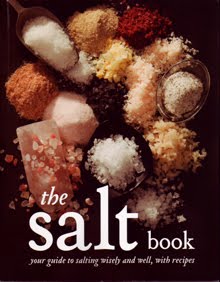
A little research in a book I have, The Salt Book tells me that there is a Hawaiian black lava salt as well. And no, neither salt comes from the ground black. Volcanic charcoal is added to the Hawaiian one, and the Cypriot salt has activated charcoal added. Both salts are seen as being healthier because of this, with a detoxifying effect, which many believe makes it healthier.

I’d rather think of it as a rather wacky seasoning. One that adds a dramatic twist to dishes. A certain zappy colour accent.

Consider these recent menu items and picture the effect: butter poached Western Australian marron, foie gras parfait, sprinklings of salmon roe and black Cyprian salt, (The Point, Albert Park, Melbourne) and a salt and butter flight of goat's butter with red Hawaiian sea salt, Vermont butter with black Cyprian salt, and parmigiano reggiano butter topped with truffle salt, (Juicy, Chicago).

Interestingly there is another salt, Indian black salt or kala namak that is a powdery pink. Some say it has the aroma of cooked eggs, and is recommended in ayurvedic medicine as a digestive, and in India is thought to be useful for people with high blood pressure and those on low-salt diets, and also generally for indigestion.

Who knows!

First-century AD Roman author and naturalist, Pliny the elder, not always the most reliable scientific guru, refers to Cyprian salt as a “precious stone”. In its white state it was also mentioned by Hippocrates, the father of medicine. It is usually collected from coastal rocks as well as from the island’s salt lakes.

No wonder these scholars mentioned it. The Romans valued salt enormously and even paid their workers in it, which is where we get our word sal-ary from. The ancient Roman road, the Via Salaria, is still a major road leading to Rome.

And finally, just a bit of trivia: A couple of years ago I visited the Ile de Ré, just off the Atlantic coast of France. Esprit du Sel salt is still harvested from the marshes at the far end of the island and the local donkeys were once used to transport it. Unfortunately the mosquitoes and the corrosive salt irritated the legs of the poor beasts and so the farmers clad them in checked trousers for protection. The donkeys in their unusual garb became a sort of unofficial emblem of Ile de Ré.

We didn’t see any wearing these natty PJs, but here’s one we found in a mural on a cottage wall.

Thursday, September 16, 2010

A PASSIONATE TALE


I’ve been passionate about passionfruit all my life.

As a kid, growing up in a small country town in Western Australia, everyone I knew grew passionfruit – especially the long yellow ‘banana’ passionfruit. These hung off creepers that many people trailed up over the walls of the outside toilet to discreetly camouflage it – yes, it was that long ago!

I must have eaten hundreds of those. For a kid, the soft velvety skin made it so much easier to break into the fruit. Those hard purple passionfruits – much more common – required a knife and possibly adult help to open. And that was a problem, too, as they could then keep tabs on how many you were consuming.

The banana passionfruit (tacsonia) was fun to eat. Peel the skin and you then had a long ‘banana’ of closely packed, sweet, orange-fleshed seeds that broke away from each other cleanly with no juice. You could legitimately spend half an hour savouring one fruit, picking off each individual globule.

Often I didn’t, though, simply eating it monkey-fashion, the peel laid back, gobbling the sensuous sweet flesh.

Years later I found myself in Bali and met the fruit to rival my previous passion.

Like many a romance, it began fairly slowly and inauspiciously. A yellow egg-shaped fruit appeared in the breakfast buffet fruit bowl. Hmmm! A bit spotty, not much to recommend it. Unlike a ripe purple passionfruit, the skin was hard and smooth, not invitingly wrinkled.

It wasn’t much better when I cut it open. Silver grey gooey flesh around black seeds – almost like fish roe.

A cautious sniff. And a taste. This was certainly better!

I put a spoon into the half-shell and the entire glob of flesh came out obediently. No scraping as I was used to with the golden flesh of the purple passions.

And then the taste – fragrant, floral, sweet, tropical. Lychee-sweet, but the texture of passionfruit.

Of course for the rest of my time in Bali, I could not get enough of them. Everywhere, from the hotel breakfast buffet to roadside stalls where they sold for a pittance, I would fill my pockets with them, to savour them in my room as long as they lasted.

Originally I thought the name was Marquesa. It took me months to learn the Balinese name was makisa, pronounced, mah- KEE-za. I now know that the makisa has a more proper Latin name - passiflora ligularis – and that it is said to be native to the Andes. How it became so entrenched in Bali (and only few other places) is a mystery to me.

Sadly this passionfruit is rare in my corner of the world. In Bali, I am told it ripens year round, but even in Jakarta earlier this year, it took a patient hotel employee some time to track some down for me when he heard of my addiction. Thank you, Adeza, at Hotel Mulia Senayan!

Is it just me, or are there other people who plan their trip around which rare or much-covered foods are in season?

My mouth is watering, just mentioning makisas, so I’m scanning the deals on flights to Bali, right now!